 English
 Español
 عربى
 Deutsch


Barber Grade Clippers: Motor, Blade, and Buying Specs Explained for Shops
 2026.10.22
 Industry News
Content
- 1 What Barber Grade Means in Practice
- 2 Motor Speed and Torque: Reading RPM Claims Correctly
- 3 Blade Steel and Coatings That Hold an Edge
- 4 Corded or Cordless: Matching Power to the Chair
- 5 Guards, Taper Levers and Cutting Length Control
- 6 Carving Clippers Are a Separate Tool Class
- 7 A Buying Checklist for Shops and Wholesalers
- 8 Maintenance That Keeps a Blade Cutting
A barber feels it about three haircuts into a busy afternoon: the blade starts dragging through thick hair, the fade line smears, and the client shifts in the chair because the metal is running warm. That is usually not a technique problem. It is a tool problem.
Barber grade clippers are defined by three measurable things: torque that holds up under load, blade steel that keeps its edge across hundreds of cuts, and heat control that keeps the blade comfortable against skin. Colour, branding and display panels are preference, not performance.
So the working rule is simple. If you cut hair all day, buy for motor and blade first, then for battery life and noise. The sections below explain how those specifications translate into what actually happens in the chair, and what to verify before placing an order.
What Barber Grade Means in Practice
Barber grade is not a certification, and no standards body issues it. The phrase describes tools built for continuous professional duty rather than occasional home use. The gap shows up in four places: the motor, the blade, heat behaviour, and how easily the tool can be serviced.
| Specification | Consumer grade | Barber grade |
|---|---|---|
| Motor type and speed | Magnetic or low torque rotary, roughly 3,000 to 5,000 RPM | High torque rotary, commonly 6,000 to 8,000 RPM |
| Blade steel | Thin carbon or 420J2 steel, often uncoated | Hardened 3Cr13 or 420J2, with black titanium or ceramic coatings |
| Heat behaviour | Blade warms quickly under repeated use | Coating and blade geometry spread and release heat |
| Cut length control | Fixed blade with snap on guards | Taper lever plus a full guard set, 1/16 inch to 1 inch |
| Duty cycle | Short sessions with rest periods | Continuous use across a full working day |
| Serviceability | Usually replaced as a complete unit | Blade, lever and battery are replaceable parts |
Treat the table as a filter rather than a rule. A shop running six haircuts a day has different priorities from a walk in store running thirty, and the honest answer is that both can be served well by the same motor class if the blade and service parts are right.
Motor Speed and Torque: Reading RPM Claims Correctly
RPM is the easiest number to print on a box and the easiest to misread. Manufacturer specification listings for professional rotary clippers commonly sit between 6,000 and 8,000 RPM, while most home units are listed at 3,000 to 5,000 RPM.
Speed alone does not clear thick hair. Torque is what keeps the blade moving when it meets dense, damp or curly hair, and torque is exactly where pivot motors fall short. A pivot motor may oscillate at 5,000 to 6,000 strokes per minute in open air, then slow noticeably once the blade loads up. A rotary motor holds its speed under the same load, which is why it produces an even fade instead of a stepped one.
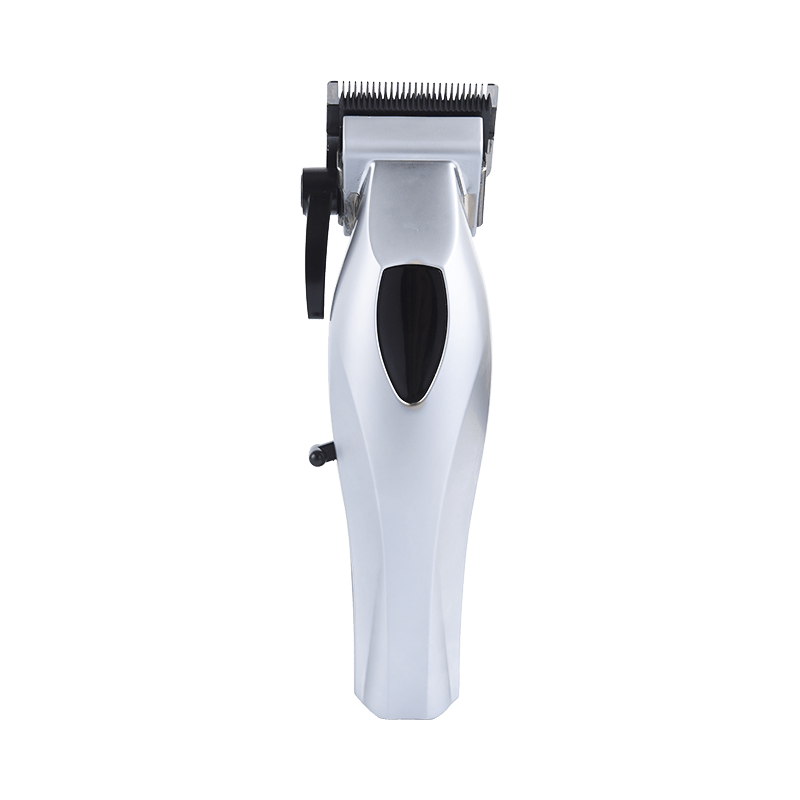
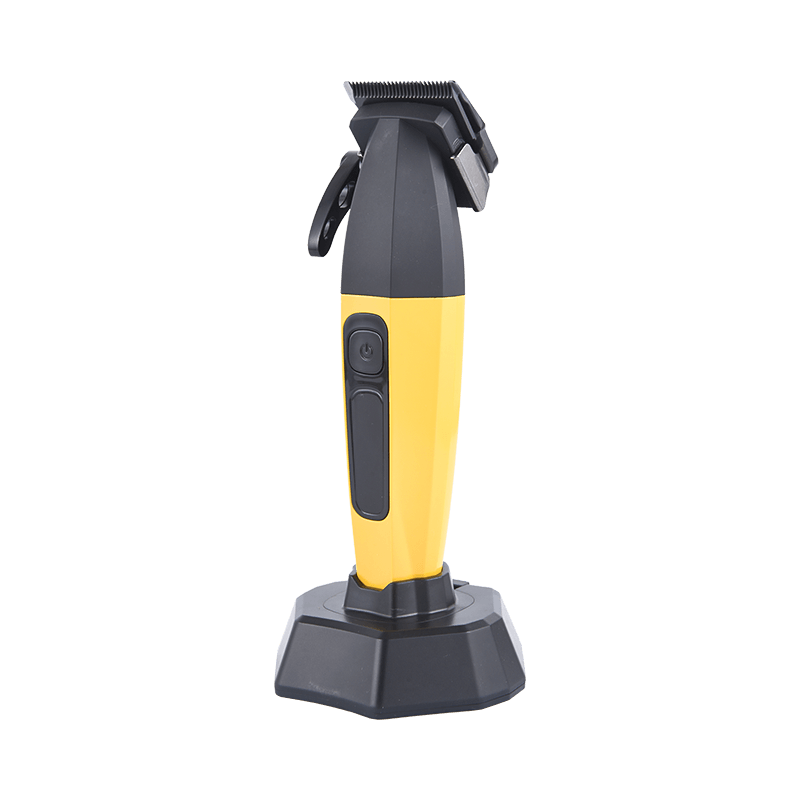 8000 RPM Professional Hair Clipper with Ceramic Titanium Blade SystemA rotary-motor clipper for thick, damp or curly hair, with ceramic titanium blades, digital battery display and up to 180 minutes per charge.View Product →
The 8000 RPM professional clipper in our range is built around that logic: a high speed rotary motor paired with a blade set that stays aligned when the load increases.
Blade Steel and Coatings That Hold an Edge
Blade material decides how long a clipper cuts cleanly and how much heat it transfers to the client. Four specifications cover most professional tools.
- 3Cr13 stainless steel. A martensitic stainless grade with roughly 12 to 13 percent chromium. Published material data sheets list hardened and tempered hardness in the region of 50 to 56 HRC, which supports good edge retention on hair.
- 420J2 stainless steel. A related grade with higher corrosion resistance and slightly lower hardness, typically around 50 to 55 HRC after heat treatment. It is a sensible choice for tools that are washed frequently.
- Black titanium and similar PVD coatings. Coating supplier data sheets report surface hardness in the 2,000 to 2,400 HV range, well above the base steel. The practical result is lower friction, less heat build up and a longer interval between sharpenings.
- Ceramic moving blades. Ceramic runs cooler than steel and resists corrosion, but it chips rather than deforms, so it suits precision and detailing work more than heavy bulk removal.
Sharpness is only half of the story. Blade alignment matters just as much, because a perfectly sharpened blade that is even slightly out of register will pull hair instead of cutting it.
Corded or Cordless: Matching Power to the Chair
Cordless tools have closed most of the performance gap. A modern lithium ion professional clipper typically delivers 2 to 4 hours of run time per charge, with charge times between 1 and 3 hours depending on the cell pack. For one barber working a standard shift, that is enough, provided the shop keeps a spare charged unit on the shelf.
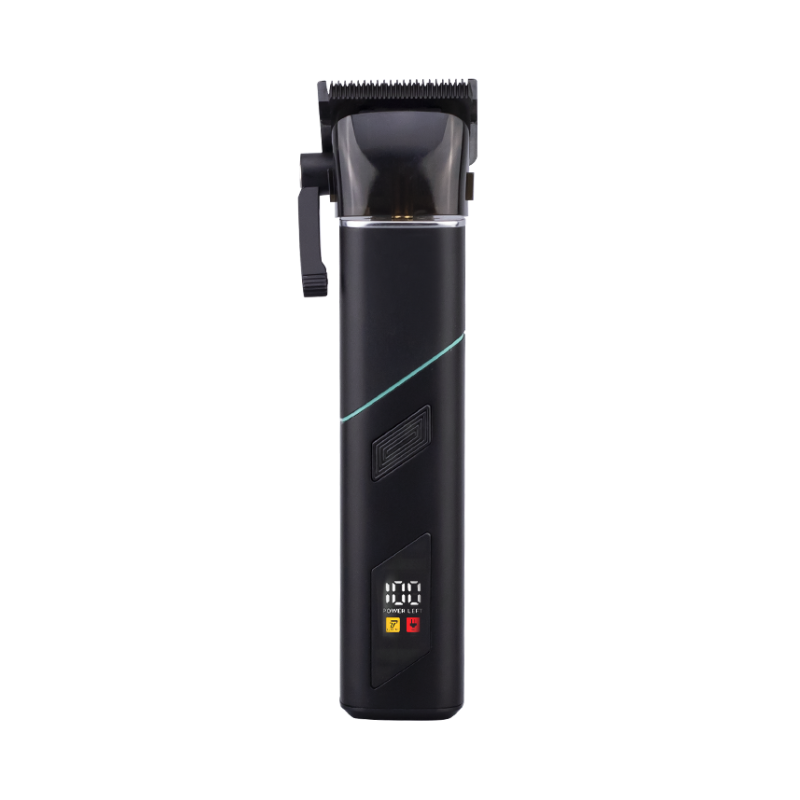 B002ZT Men's Ceramic Blade Electric Clipper SetA cordless clipper set with ceramic blade, eight limit combs, Type-C charging, digital display and use-while-charging convenience for home or detailed styling.View Product →
Our professional cordless model b002zt is aimed at that routine: full shift use without a cable, with the battery pack treated as a replaceable part rather than a sealed component.
Corded clippers still make sense in high volume shops. They are lighter in the hand because there is no cell pack, they never stop mid cut, and there is no battery to fade after a few hundred charge cycles. Many working stations keep one of each: cordless for mobility and detailing, corded for bulk work and back to back clients.
Guards, Taper Levers and Cutting Length Control
Cut length control is where inexpensive tools quietly fail. A complete professional guard set usually runs from 1/16 inch through 1/8, 1/4, 3/8, 1/2, 5/8, 3/4 and 7/8 up to 1 inch. Guards have to clip on tightly. A loose guard vibrates, shifts, and leaves lines the barber then has to correct.
The taper lever covers the fine range. On most professional clippers it moves the cutting length from roughly 0.5 mm to 2.5 mm without changing the guard, which is what makes a seamless fade possible in the first place. Check lever travel on a sample unit before ordering in volume. A lever with a gritty or slack feel will be felt hundreds of times a day.
Carving Clippers Are a Separate Tool Class
Line work, hard part designs and outline detailing are not jobs for a bulk clipper with a wide blade. Carving clippers use a narrow, usually T shaped blade and a shorter stroke, which lets the barber cut a defined edge without overrunning the line. The differences in blade geometry and stroke are explained in this breakdown of how a carving hair clipper works.
For shop use, the deciding factors are blade width, edge sharpness out of the box, and how well the blade holds alignment after repeated line work. A carving blade that drifts even slightly produces curved outlines instead of crisp ones.
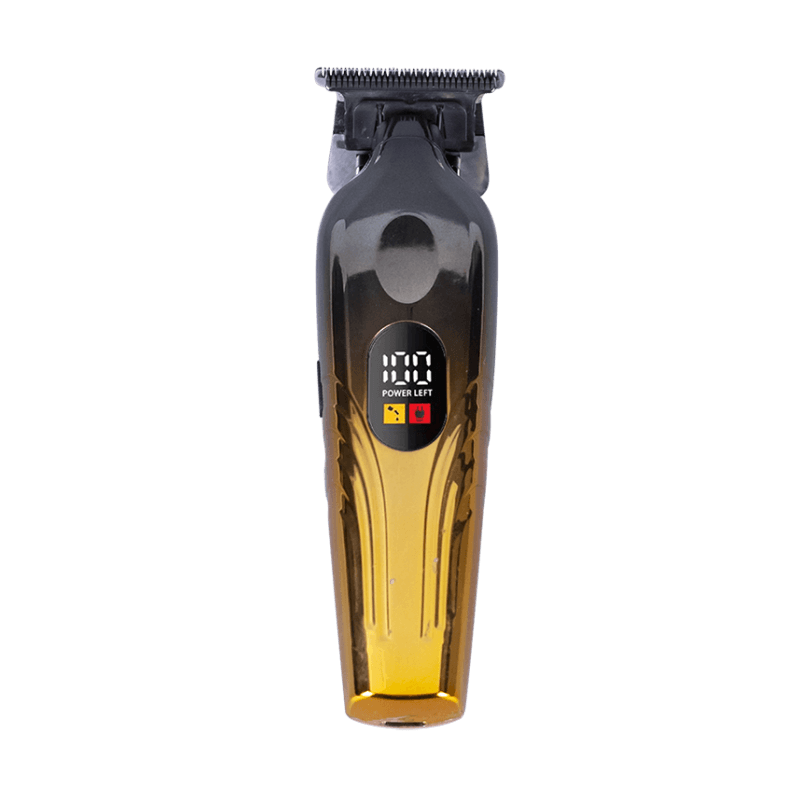 A004SD Barbershop Carving Clipper with LED DisplayA narrow-profile carving clipper for outlines, necklines and pattern work, with ceramic cutter head, R-shaped blade and LED status display.View Product →
The a004sd barbershop specific carving clipper was developed for that duty, with a narrow blade profile intended for outlines, necklines and pattern work.
A Buying Checklist for Shops and Wholesalers
When you are comparing quotes, run each model against the same short list.
- Confirm the motor type before the RPM figure. Rotary for bulk work and fades, pivot or magnetic for lighter trimming.
- Ask for the blade steel grade and hardness range in writing. If a supplier cannot state it, the tool is probably not built for professional duty.
- Test the taper lever on a sample unit. Travel should be smooth across the full range with no dead zone.
- Check that blade, lever and battery are listed as replaceable parts rather than sealed assemblies.
- For cordless models, confirm run time, charge time, and whether the battery pack can be ordered separately.
- Order one sample per model before committing to volume. Twenty minutes on a real client tells you more than any specification sheet.
Specifications on paper only mean something if the tool is produced consistently. Our production lines run automated injection moulding, standardised assembly and automated packaging, and a new plant funded by a 50 million yuan budget is expected to reach 80 million yuan in annual output value. For buyers this matters because blade alignment and motor consistency come down to process control rather than marketing language.
Maintenance That Keeps a Blade Cutting
Most premature blade wear comes from hair and grit trapped between the moving and fixed blades, not from cutting hair itself. A short routine extends blade life considerably.
- Brush out hair after every few clients, and never let clippings sit overnight.
- Oil the blade with clipper oil before each shift and again after cleaning.
- Do not run a blade dry, and do not use it with a loose or cracked guard.
- Replace a blade once it pulls rather than cuts. Resharpening is possible, but a worn blade rarely returns to factory geometry.
Barber grade clippers are ultimately judged in the chair, not on the specification sheet. A tool that holds its speed, keeps its edge and stays cool turns a hard afternoon into an ordinary one. If you are sourcing for a shop, a salon group or a distribution channel, start with the motor and the blade, then confirm the details that keep a station running: replaceable parts, a working taper lever and a battery pack that can be reordered. That combination, rather than the highest RPM figure on a box, is what barbers actually pay for.
- ADD: Room 301, Building 5, Xiaocao'e (Hangzhou Bay) Electromechanical Industrial Park, Yuyao City
- Tel:+86 13805803689 / +86 13805803356
- Email: 269354157@qq.com
Copyright Ningbo Jiaweidi Electric Appliance Co., Ltd. All Rights Reserved.
OEM/ODM personal electric hair push manufacturer
Custom Electric Push Shear Carving Push Factory
